Two more Princeton professors — one in psychology and the other in computer science — have books coming out in early February, both published by the Princeton University Press.
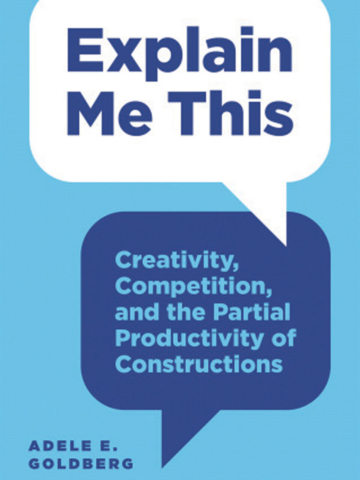
Adele Goldberg, a psychology professor who specializes in cognitive linguistics, has written “Explain Me This: Creativity, Competition, and the Partial Productivity of Constructions.” In it she addresses the paradox of “partial productivity”: why and how native speakers of a language know not to use certain expressions, even though their meaning is perfectly clear, and even though a grammatically identical expression with slightly different words could be perfectly correct.
As Goldberg explains: “We might confess that someone is driving us crazy (or bananas or insane), but we know that it would sound odd to complain that someone is driving us angry.” English speakers, she writes, will know there is something not-quite-right about “driving us angry,” but might not be able to explain why it is wrong but still will fully understand the sentiment the speaker is trying to convey.
“How is it,” Goldberg asks, “that native speakers know to avoid certain expressions while nonetheless using language in creative ways?”
The book — intended for an academic audience — delves deep into the formulation of utterances: how do we learn the meanings of words, how do we learn to combine those words in meaningful ways, and how does our memory process these formulations?
Ken Steiglitz, a professor emeritus of computer science, has written “The Discrete Charm of the Machine: Why the World Became Digital.”
In an introductory section titled “To the Reader” — whom he describes, ideally, as “interested in science generally, perhaps computers in particular, but is not technically trained” — he explains the book’s purpose:
“The machines we call computers have reshaped our lives, and may in the end transform humanity itself. The revolution is based on just one idea: build devices that store and manipulate information in the form of discrete bits. My aim is to explain why this seemingly simple idea is so powerful.
“It happens without trying that in pinpointing the virtues of the discrete, digital form, questions arise about the limits of the spectacular progress in technology we’ve seen in the past half century. Computers are cramming more components into smaller spaces, operating faster and faster. Can this go on forever? Computer programs are getting more clever. Are there problems that will always be beyond the reach of computers? Will computers become more clever than we? Will they replace us?
“At the end of this book, we return to the opening theme and pose a further fundamental question: Will digital computers always be superior to analog computers, which use information in continuous, nondiscrete form, or is there some ‘magic’ that remains hidden in the analog world, beyond the reach of the digital computer? The human brain uses both digital and analog forms of information — is Nature keeping some secrets to herself about the ultimate nature of human computation?”
This article was originally published in the February 2019 Princeton Echo.