This article was originally published in the September 2018 Princeton Echo.
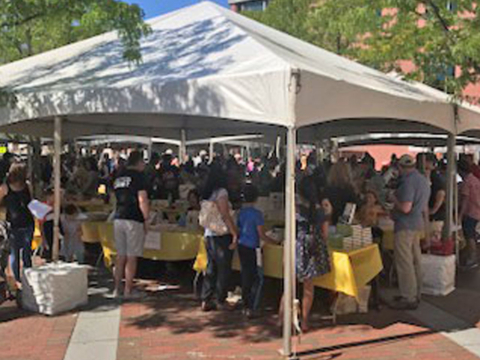
On Saturday, September 23, kids and families will gather under tents in Hinds Plaza for an afternoon of pure fun: facepainting and games, pop corn and ice cream, music and laughter. But the event is a fundraiser for a serious cause: Send Hunger Packing Princeton (SHUPP), a nonprofit dedicated to addressing food insecurity among students in Princeton schools.
It’s no secret that it’s hard to concentrate when you’re hungry: if you don’t know when or what your next meal might be, are you thinking about food or about your math homework? This is reality for roughly 500 students in the Princeton Public Schools. Instead of being hungry for knowledge, they are hungry for food — and that type of hunger makes it hard to concentrate on learning.
Much of this population is assisted during the school day by federal programs that subsidize free or reduced-price school lunches. Then the weekend comes, and the reliable source of food is gone until Monday.
That was the issue facing the Princeton Human Services Commission and its chair, Ross Wishnick, when a meeting was convened in 2012 with residents concerned about Princeton’s hunger problem. “The purpose was to do a very simple thing,” Wishnick says. “Why don’t we figure out who provides food and just sort of point?” The end result was a double-sided page with a map on one side and a schedule of food providers on the other.
That was a start, but it did not fully address the problem of kids who go hungry all weekend. And then, Wishnick recalls, one of the people at the meeting happened to be an employee of the Mercer Street Friends food bank and mentioned the backpack program already in place in Trenton and Ewing. Meals for the weekend are quietly placed in students’ backpacks on Friday afternoon, and kids who might have gone hungry would now have breakfast and lunch for Saturday and Sunday.
This was the beginning of Send Hunger Packing Princeton. With support from the Princeton Public Schools superintendent and seed money from Princeton University and the Bonner Foundation, SHUPP started supplying weekend meals for students in need at Princeton’s four elementary schools.
“We were pretty much a triumvirate — Human Services, Princeton University, Mercer Street Friends,” Wishnick says, “a good, closed system.” Money raised by SHUPP was administered by Mercer Street Friends, which provided and bagged the food. The schools sent a driver to the Mercer Street Friends food bank in Ewing to pick up the meals and deliver them to the schools.
From there expansion happened naturally. “When Princeton Nursery School heard what we were doing the director called and said, ‘we’d love to be a part of this, can we?’ We said absolutely,” says Wishnick, who adds, “We are private, no government money, and we don’t ask immigration or income status.”
Six years and more than 110,000 meals later, the organization is still growing and still working constantly for funding and for recognition. Expanding to middle and high school grades presented new psychographic challenges, Wishnick notes. “Kids are more aware so they’re more sensitive.”
There is also the question of summer. “All kids are somewhere during the school year that we can access,” he says. “The challenge has been in the summer when we can’t find everybody.” The solution was participating with the Princeton Children’s Fund to help level the playing field at summer camp. “We’re not providing PB&J while everybody else gets hamburgers. All we do is provide money and everybody gets the exact same thing.”
Another challenge is providing fresh food like fruits and vegetables. The weekend meals are by necessity shelf-stable because the school district only picks them up once a month. There have been talks of creating a “container farm” — a farm built in a steel shipping container that lasts 12 months a year.
But SHUPP’s primary concern is fundraising. The all-volunteer group that received its 501(c)3 designation this year does not collect food — Mercer Street Friends takes care of that. And fundraisin is what the September 23 event is all about.
“We’re a little crazy because we always do something different,” Wishnick says. Past fundraisers have included a screening of the film “A Place at the Table” at the Garden Theater along with a talk by filmmaker Lori Silverbush, the wife of New York City restaurateur Tom Colicchio. Last year’s event was a “Fill the Bowls” fundraiser, where the $50 price of admission came with a handcrafted bowl made by a Hightstown-based potter. Attendees ate from the SHUPP-stamped bowls and then took them home to serve as a reminder of the cause.
Two years ago SHUPP hosted a hunger banquet, where diners were randomly assigned to a poor table, a middle income table, and a rich table, with food provided by area restaurants. What happened next was eye-opening. “People from the rich table were taking their plates over to the other tables that just had PB&J,” Wishnick says. “It was just organic.”
While past events have been geared toward adults, this year’s fundraiser is aimed specifically at kids. The cost of admission is $20 per child — free for adults. SHUPP, Wishnick says, is “always in the awareness-building business,” and the shift in audience for this event is intended to “bring about recognition by bringing out a different set of people who will add to our mailing list.”
Wishnick reflects back on SHUPP’s early days. “If I think back to that — I’m not sure I would have given so much money to us when we didn’t fully exist yet. We were just an idea. But an idea created by people who were really committed to this concept, this idea of feeding people and kids.”