The Princeton University campus and surrounding town are the sites of several new and upcoming works on public art.
One not-so-new work on the Princeton campus, prominent American architect and artist Maya Lin’s “The Princeton Line,” will be joined by the second part of Lin’s campus installation, “Einstein’s Table,” on Tuesday, November 5. Lin will discuss her site-specific artworks during a public program that evening at 5 p.m. at the university’s Richardson Auditorium Tickets are required.
“The Princeton Line,” installed in 2018 near the Lewis Art Complex, is one of Lin’s series of earth drawings, outdoor earth sculptures that meld two-and three-art practices and space. Its name memorializes the former Dinky train line that once extended nearby.
The 2019 “Einstein’s Table” is an 11-foot diameter granite “water table” with an elliptical shape to recall the Earth’s solar orbit, subtle white stone reminiscent the Milky Way in the night sky, and a design that pays homage to onetime Princeton resident Albert Einstein and his theory on black holes. Website
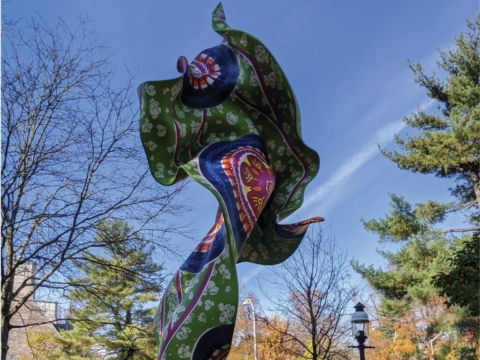
Nearby, just north of the Dinky Bar and Kitchen, a colorful, abstract form has risen from a lawn there. It is British-Nigerian artist Yinka Shonibare’s “Wind Sculpture (SG) IV,” on loan from a private collection through May 2020.
The 23-foot sculpture is made of hand-painted and glass-reinforced polyester supported by a steel armature, but the materials give the appearance of a textile blowing in the wind. The coloring is rooted in the patterns of Indonesian-style batik cloth, which, for the artist, symbolizes the ways textiles transmit culture through economies of trade, colonial enterprise and migrating or traveling bodies.
Across campus, Walter Hood’s 39-foot-tall “Double Sights” was unveiled in October in Scudder Plaza, outside the Woodrow Wilson School. The installation, two pillars leaning against each other, is inscribed with quotations by Wilson and his critics. The piece was intended to provide a complete view of the former president’s legacy, both his positive accomplishments and the ugly racism that has led Princeton students and others to demand his name be removed from the school. The problem, as many who have tried to inspect the sculpture have noted, is that, as the pillars tower well above eye level, many of the words are near-impossible to read.
On Springdale Road just before the Institute for Advanced Study’s housing starts, a 30-foot stretch of a plain wooden fence is now the site of an eco relief mural, “Life Along Springdale Road,” by Mary Waltham. The Princeton resident used entirely found materials from the nearby Institute woods.